Budtenders Association (BTA) – Learn & Earn™ | Market Intelligence | Brand Health Insights
Welcome to Budtenders Association
This website contains cannabis-related content intended for adults. To continue, please confirm that you are of legal age to access cannabis content in your province, territory, or country.
We connect Budtenders, consumers, and brands to help shape the future cannabis.Become a Member
What is a cannabis Sensemillier, and how can you become one?
What is a Cannabis Sensemillier?
Chances are, you’ve heard of a wine Sommelier—those wine experts who can recommend the perfect pairing for your meal and explain the subtle differences between a Cabernet and a Merlot. But what does that have to do with cannabis?
The term “Cannabis Sommelier” was borrowed from the liquor industry, particularly the wine sector, where “Wine Sommeliers” are experts in wine education and identification.
“In French, the word Sommelier literally means ‘butler,” and it’s been used since the 19th century to mean ‘wine steward’ or ‘wine waiter.'” – vocabulary.com
Today, a wine Sommelier is recognized as a trained and knowledgeable wine professional, typically working in fine dining establishments.
Their responsibilities include: + Curating wine lists. + Advising customers on wine choices. + Serving wine. + Often managing the wine cellar.
Their expertise usually covers:
+ Education on wine history and production + Sensory evaluation of wine + Vast knowledge of different wine types and brands + Selecting different types of wine based on customer preferences
As you can see, the word “Sommelier” is very much linked to the wine industry.
So, does it make sense to use the same terminology for an entirely different drug type like cannabis? Not really. After all, we’re dealing with a completely different plant, a different sensory experience, and a whole other set of benefits.
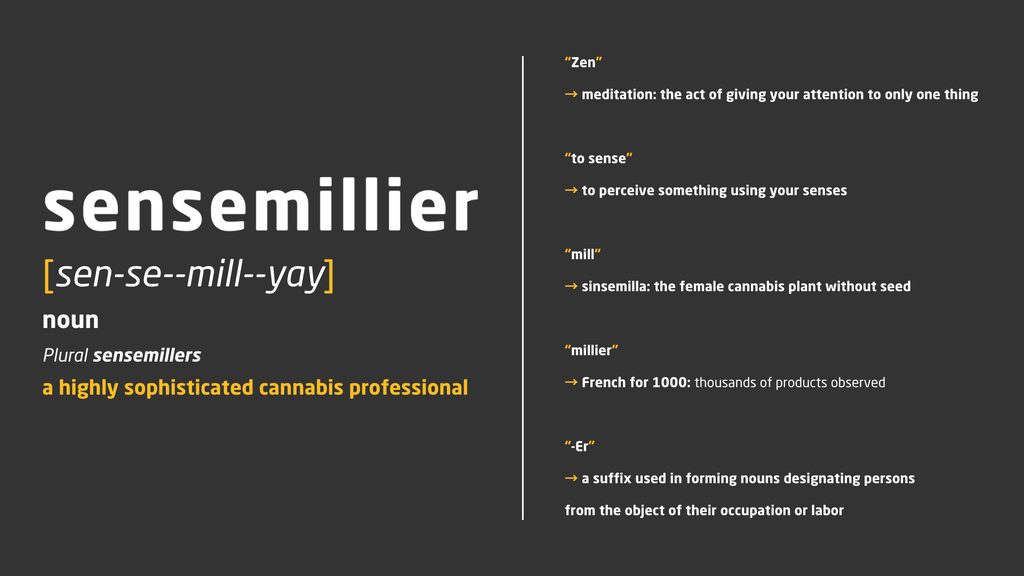
That’s why we would like to introduce you to a new and more accurate term that refers to a highly sophisticated cannabis professional – The Sensemillier.
The term Sensemillier is a blend of the Spanish word “Sinsemilla,” meaning “without seed,” and the English word “senses” or “ to sense,” as a cannabis Sensemillier is a master in using their senses to evaluate every key characteristic of a cannabis plant.
And just like wine sommeliers work with fine wines, Sensemilliers often work with sinsemilla—high-quality, seedless female cannabis plants known for their rich phytochemicals (all the good stuff that makes cannabis so special).
Now that we know what the term Sensemillier means, let’s look at where such a person works, what skills they must have and what they need to know about cannabis.
What does a Cannabis Sensemillier need to know?
A cannabis Sensemillier can be found in every facet of the cannabis industry, whether it’s in a store, at a production facility or amongst passionate cannabis consumers.
In a professional setting, the Sensemillier takes on responsibilities like:
Curating the product portfolio
Advising consumers on cannabis choices
Serving cannabis
Writing strain cards & product information
Therefore, their expertise needs to cover:
Education on cannabis history, production and effects
Sensory evaluation of cannabis
Vast knowledge of cannabis products and brands
Selecting different types of cannabis based on customer preference
In addition to these, a Sensemillier must have sufficient social skills and be able to efficiently educate clients and co-workers.
Outside of a professional retail or production setting, a Sensemillier can also become a recognized cannabis reviewer and entrepreneur with the ability to monetize their expertise and product assessments.
To acquire and maintain their unique skillset, Sensemilliers need to combine theoretical cannabis knowledge with first-hand experience of various products and brands.
To do so, the Sensemilliers usually keep a physical or digital journal filled with notes about the things they’ve learned about cannabis and tasting notes about the various products they have tried and assessed. Establishing a cannabis journal helps the Sensemilliers to capture new information and recall relevant strain highlights and cannabis education.
While most of the theoretical cannabis education is based on simple memory recall of different topics, the practical part of a Sensemillier skillset is a lifelong practice of evaluating various cannabis types for their sensory and medical properties.
The evaluation process not only helps the Sensemillier to identify relevant product features but also supports them in building their cannabis assessment skills and flavour palette.
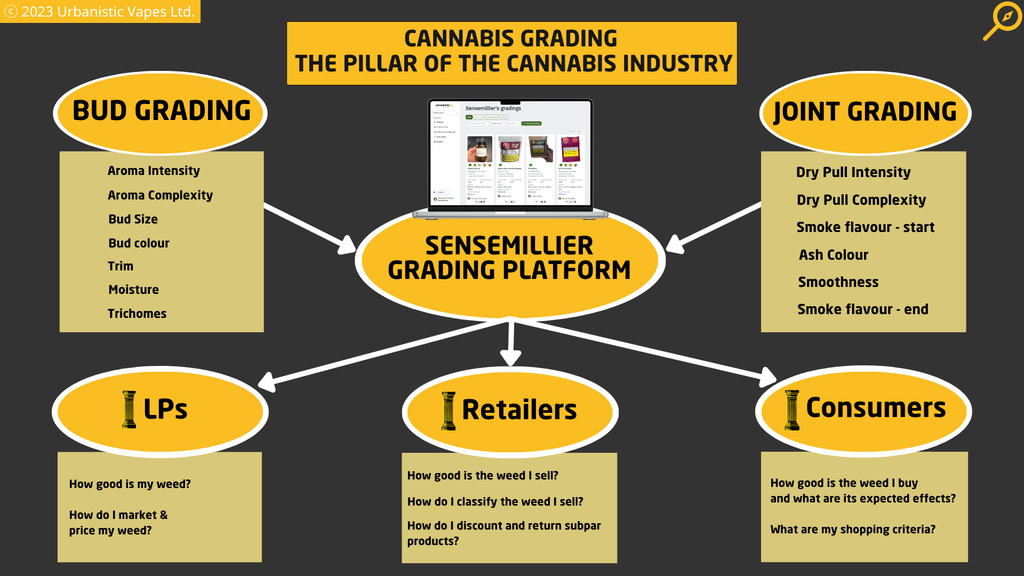
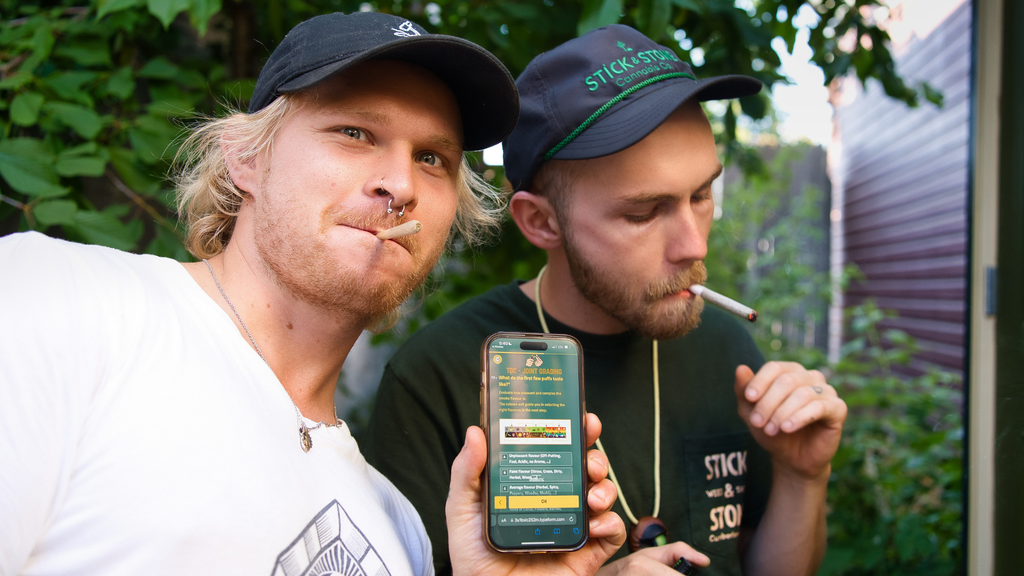
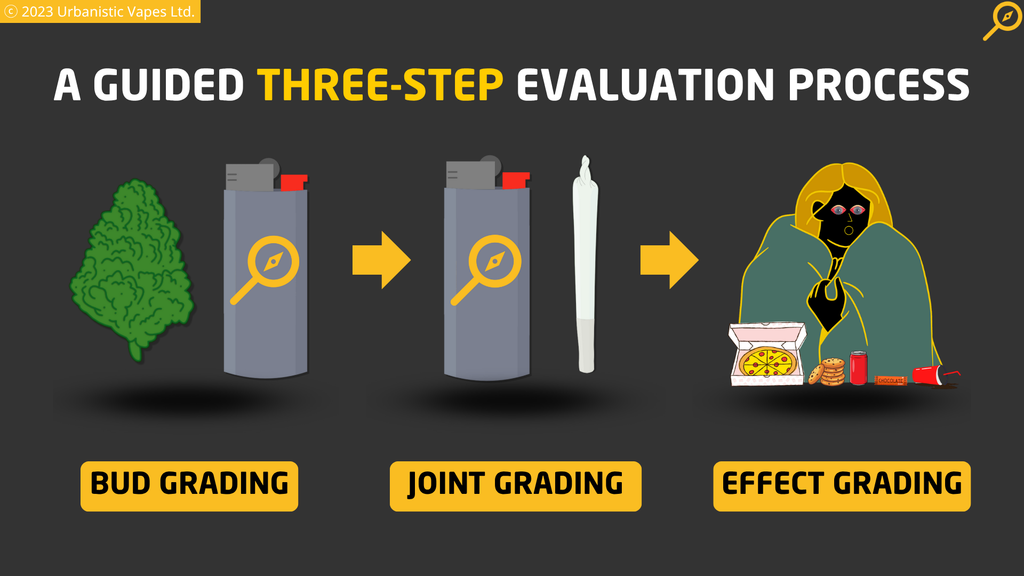
To support aspiring cannabis Sensemilliers with practicing their product assessments, we created the Sensemillier Grading Platform that guides the user through a guided cannabis evaluation while keeping track of all the products they tested.
How to become a Cannabis Sensemillier
Anybody who’s passionate about cannabis and eager to dedicate their time to learning about cannabis and assessing various products can become a Sensemillier.
The path and professional opportunities of a Sensemillier aren’t linear.
While there is a preconceived idea about what a Sensemillier needs to know about cannabis, there are various ways to acquire this essential knowledge.
My path led me through various blogs, articles, books, and certifications to establish a solid foundational cannabis expertise, which improved even further through my rigorous assessment of various cannabis products. I also gained first-hand experience in the industry by working as a budtender, store manager, staff trainer, and on the production team at a facility.
Reaching a point where I felt like I finally really understood the complexity of this plant and its industry has been a lengthy process that led me in and out of the rabbit hole of cannabis education, which is filled with misinformation and irrelevant knowledge that I had to filter through.
Because I didn’t want others to spin in circles as I did, we created the Sensemillier Grading Platformto give upcoming Sensemillers a guided tool that teaches them how to evaluate cannabis quality and stores their records so they can use the product insights they gained to learn more about their personal preferences and create engaging strain cards and product reviews.
For anyone who wants to jumpstart their cannabis career and Senemillier journey, we have also established our Sensemillier Grading Masterclass, which covers the foundational education every cannabis Sensemillier needs to know.
As I said, the path to becoming a Sensemillier isn’t linear. All it takes to monetize your expertise as a cannabis professional and get paid to evaluate and consume cannabis products is a burning desire, passion and the right tools to make it happen. We made it happen, and we’re happy to share the lessons we’ve learned on our path to help you make your Sensemillier dreams come true.
So, if you have any questions, please feel free to message us on Instagram @sensemillier or send us an email to [email protected].
We’re looking forward to accompanying you on your cannabis journey.
Ready to take your cannabis knowledge beyond THC percentages and strain names?
The Sensemillier program gives cannabis professionals a structured way to evaluate product quality, build sensory expertise, and learn how to assess cannabis more consistently and confidently. Create a free account on the Sensemillier Grading Platform and evaluate one or two products yourself. It’s the fastest way to see how structured grading can transform the way you understand cannabis.
Retail Managers: Want to bring structured grading to your store? Visit Sensemillier to explore the program and learn more.
When observing & consuming different cannabis buds and their unique differences and qualities, we quickly start to understand why the “it’s just weed” people are undoubtedly wrong in their perception of cannabis.
But why isn’t each type of cannabis the same? And how and why can the quality of each type of cannabis differ so much?
What is Sensory Cannabis Quality?
Okay, let’s kick this off with the first question: Why isn’t each type of cannabis the same?
If you have had any experience with cannabis so far, you likely have heard of the terms “Indica,” “Sativa,” and “Hybrid.” The general emphasis around these words is that “Indica” types are generally supposed to be more sedative, while “Sativa” types are supposed to be more energizing, and “Hybrid” types are somewhat between sedative and energizing.
I shall mention at this point that these terms really don’t mean much, but I won’t get into too much detail on why that is, as I could write an entire article about that topic – maybe I will one day, but let’s stay focused on the quality for now, shall we?
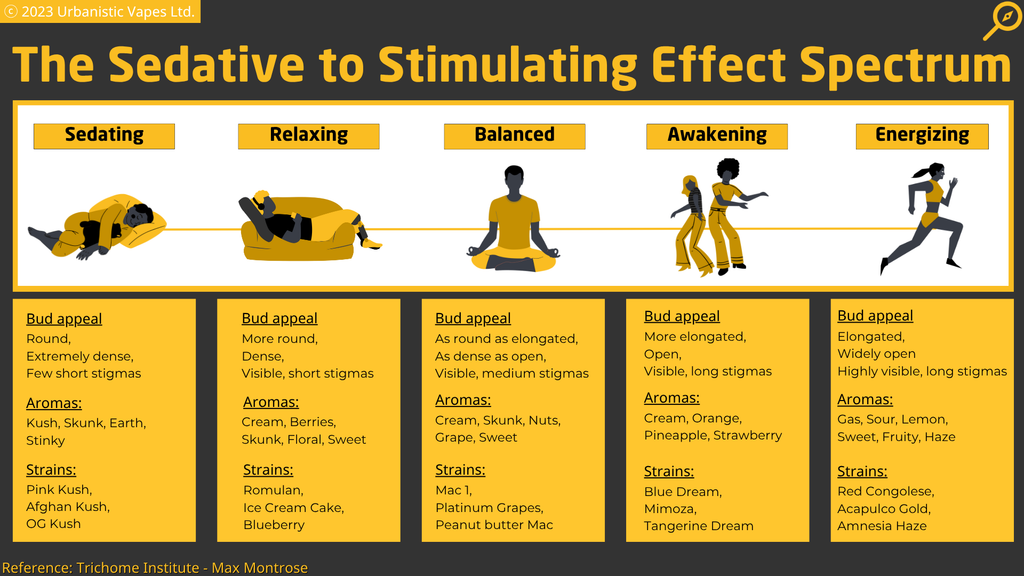
So, the reason why I’m bringing this up is because I’d like you to understand that there are different cannabis types with specific intoxicating properties that range from sedative to stimulating.
As a matter of fact, we can say that the effects of all cannabis varieties can fall under a sedative to stimulating effect spectrum.
A Pink or Afghan Kush variety, for example, is usually on the far-sedative side of this spectrum, while an Amnesia Haze or Congolese strain is on the far-energizing side of the spectrum.
The reason for these sedatives or energizing effects is based on the so-called Entourage effect, which is the hypothesis that the various plant-based chemicals in the trichome heads of these varieties create a unique bouquet of compounds that include cannabinoids, terpenes, volatile sulphur compounds (VSC), esters and various other phytochemicals (plant-based compounds).
When we discuss distinct varieties like a Pink Kush, for example, it’s essential to know that these varieties are bound to a so-called genotype and a chemotype.
The plant’s Genotype refers to the plant’s genetic profile and suggests how these genes should be expressed in the overall appeal, including the plant’s aromatic profile and trichome expression. These factors are part of the sensory quality of cannabis, as they’re all aspects we can perceive about the cannabis by using our senses.
The Chemotype refers to a plant’s chemical profile, suggesting what range of chemicals the plant should express. For example, researchers often classify cannabis varieties as a Type I (THC-dominant), Type II (balanced CBD:THC) or Type III (CBD-dominant) Chemovar.
Now, you might think, “Nice nerd out, but what does that have to do with quality?”
I’m glad you asked.
Let’s quickly reroute to the genotype. Once again, a genotype tells us what the sensory quality – looks and smell – should be like. However, with the plant’s genotype in mind, we can now compare these metrics to the plant’s phenotype, which is another nerdy word that simply means, “This is what my plant actually looks like.”
So, for example, a Pink Kush variety should typically have a dense, compact bud structure with vibrant pink and purple hues interspersed with deep green. Its aroma profile is often described as being very earthy and kushy, with perhaps some underlying floral notes. The trichome coverage should be heavy, giving the buds a frosty appearance. (= Genotype – what the plant should be like)
However, the actual Phenotype (how the plant looks in reality) can vary based on growing conditions, cultivation techniques, and slight genetic variations. This is where quality assessment becomes crucial.
When we evaluate cannabis quality, we compare the actual Phenotype to the expected Genotype, among other things that we will discuss in the next section. Proper cannabis should, therefore, closely match the characteristics defined by its Genotype.
Or, to say it less nerdy, if you buy a Pink Kush that is elongated and smells like fruits, you’ve just bought something that is named Pink Kush but doesn’t resemble the actual variety at all. In that case, this fake Pink Kush is likely not only looking and smelling like a Pink Kush, but will also give you a much different buzz than a Pink Kush would.
Each type of cannabis isn’t the same because the plants vary genetically in their appearance, aroma and chemical profile. Further, each distinct type can vary and morph into different varieties based on how the phenotype expresses itself. This is influenced by various factors such as the growing conditions, cultivation techniques, and slight genetic variations.
Now that we have this covered, let’s explore what cannabis quality generally is before we explore how and why the overall quality of cannabis can differ so much.
To do so, I’d like to shift our focus now primarily to sensory quality, which is the observable characteristics of a cannabis type that we can assess through our senses.
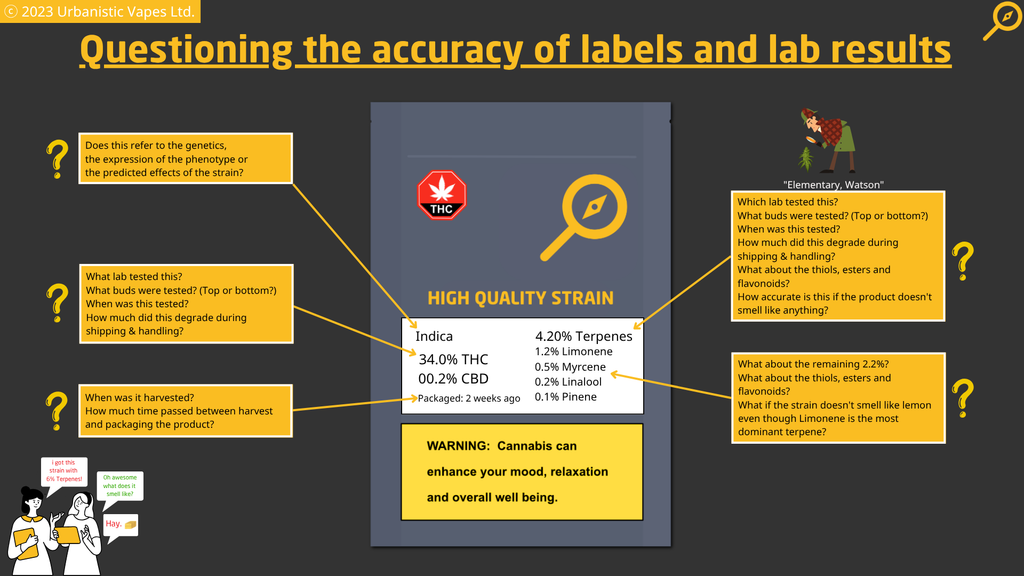
That being said, I will spend little time discussing THC and Terpene percentages as the lab numbers are, from my point of view, more like an indicator of medical ingredients rather than the overall quality of a cannabis bud.
To understand my point of view, let’s think about buying and consuming apples.
Imagine this: You go into the produce section of your grocery store to hunt down some delicious apples. As you explore the aisles, you notice different varieties of apples. There are Pink Lady apples, Cosmic Crisp apples, Ambrosia apples and so on. Now, you have to decide what apples you want to buy, so you walk up to the staff of the grocery store and ask them, “Please tell me the calorie and vitamin differences of each different apple variety and recommend the best apple.” The grocery staff member – who has no idea what apple taste you prefer or what vitamins your body needs, by the way – responds with, “You see the pile of half-rotten, brown apples over there? Those tested with the highest calories and have a great vitamin content.”
You buy the half-rotten apples, take a bite, and are barely able to finish the entire thing as it tastes like shit and minutes later, your stomach aches, and you’re about to shit yourself, but hey, you’re happy that you got the highest calories and most vitamins.
Now that you hopefully understand why sensory quality (including your own preferences) is more important than just the lab results*, let’s quickly summarize what sensory product quality can tell us:
Potential health risks when consuming the product: Mouldy and harsh products, for example, can affect your health negatively.
The pleasantness of consuming the product: When consuming a product, we mostly want something pleasant to consume, providing a great appeal, aroma, flavour and smooth smoke/vape.
The potential effects/intoxication from consuming the product: The aroma intensity, complexity, variety, overall appeal, and trichome coverage can give us some solid indicators of what the effects of the product can be like.
The efforts and artistic craft behind the growing and handling of the product: The sensory quality of a product shows us how much expertise and care the growers took to cultivate an outstanding or poor variety.
How to differentiate various products: The sensory quality varies highly from product to product and, therefore, helps us to differentiate the abundance of products in a cannabis store based on the actual product quality instead of just strain names, THC numbers and price points.
*I just want to quickly mention here that I still value the lab tests, especially the evaluation of microbes, heavy metals and pesticides, which surely help keep consumers safe. I’m simply not shopping for cannabis based on THC and Terpene percentages, as just following the numbers is often misleading and doesn’t give you the full picture of what you’re about to purchase.
Now that you have had a quick intro to sensory cannabis quality and what it can indicate, let’s jump right into the rabbit hole of sensory quality evaluation.
Sensory Bud and Smoke Quality
Let’s start off with our question again. How and why can the quality of each type of cannabis differ so much? To understand how the sensory quality of cannabis can differ so much, let’s explore the sensory quality indicators that we evaluate in our Sensemillier Grading Platform.
In our platform, we separate the sensory quality of cannabis into two main categories:
Bud quality
and Smoke or Vape quality.
These main categories are then further broken down into subcategories.
The Subcategories for the Bud quality are:
Aroma
Appeal
Trichomes & Undesirables
Curing
The Subcategories for the Smoke quality are:
Dry pull flavour
Smoke flavour
Ash colour
Smoothness
Let’s explore each subcategory in more detail and show you some insights from our Grading Platform so you can better understand the various factors that make up product quality and how to evaluate them.
Aroma (Bud Grading)
The Aroma includes the following grading aspects:
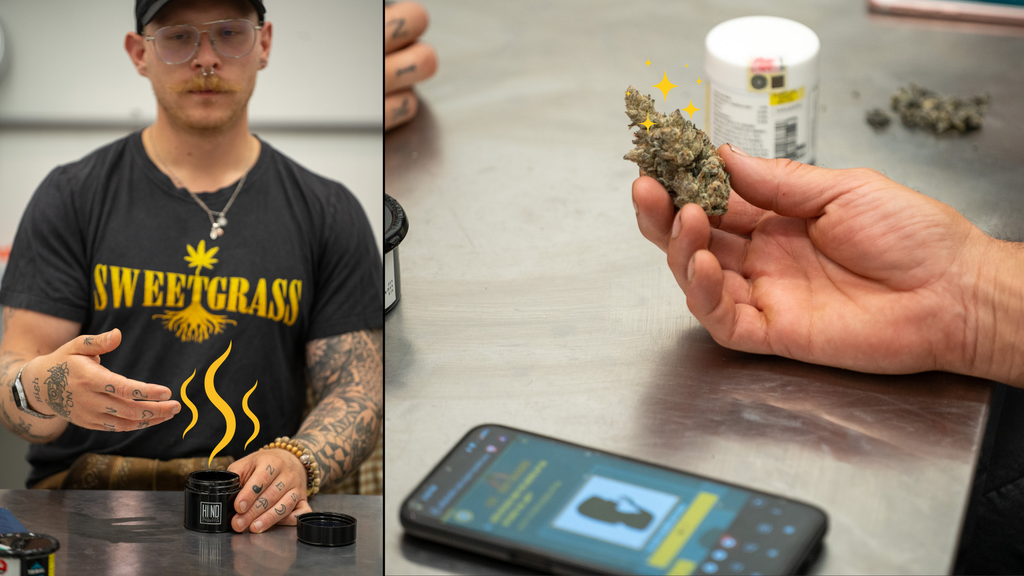
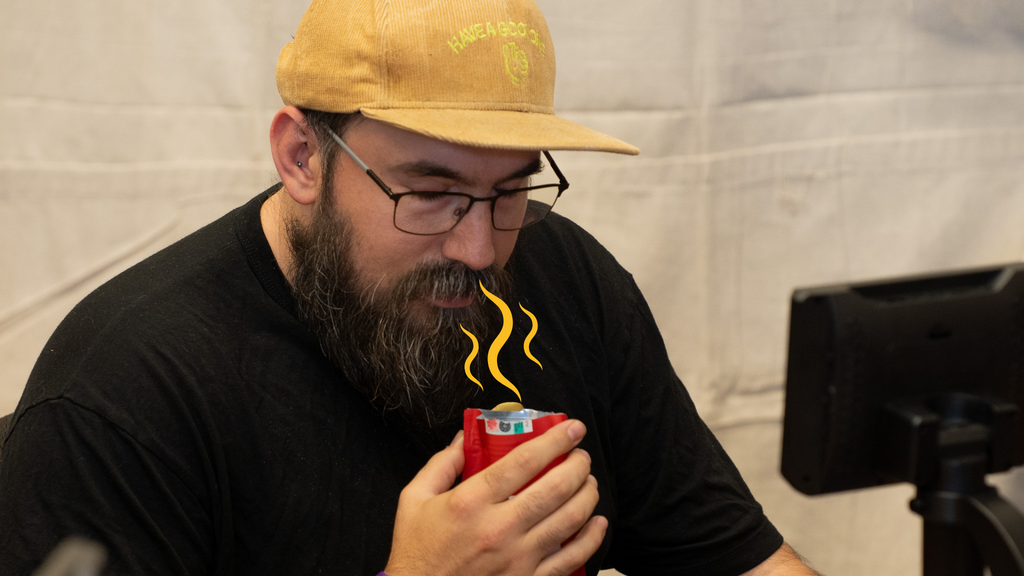
Aroma Intensity To evaluate the Aroma Intensity, we start by opening the product packaging from an underarm’s length away from our chest to see if the aroma is noticeable from a distance and fills the room. If we can’t smell the aroma from there, we reduce the distance by bringing the packaging to our chest and continue with this process until we can pick up the distinct smell of the buds – the last step is having the jar or pouch right under our nose.
We evaluate the Aroma Intensity in this way because cannabis is a unique plant that can produce intense fragrances like barely any other plant. This intensity of its aroma is dependent on the concentration of aromatic phytochemicals like Terpenes, VSC, Esters and other compounds that are said to contribute to the Entourage effect and the user experience. Consequently, the more intense its aroma, the higher the concentration of aromatic phytochemicals.
Aroma Complexity To evaluate the Aroma Complexity, we bring the container with our buds right up to our nose and gently smell its overall scent while assessing if what we smell is an unpleasant, faint, average, pleasant or complex aroma. We evaluate the aroma complexity to determine the variety of present phytochemicals and undesirables. The creamy, citrusy or gassy aroma of a bud is namely due to a high concentration of said aromatic phytochemicals, while a lack of aroma or unpleasant, off-putting or dirty smells are an indicator of unhealthy, low-quality flower that won’t be enjoyable to consume.
Appeal (Bud Grading)
The Bud Appeal includes the following grading aspects:
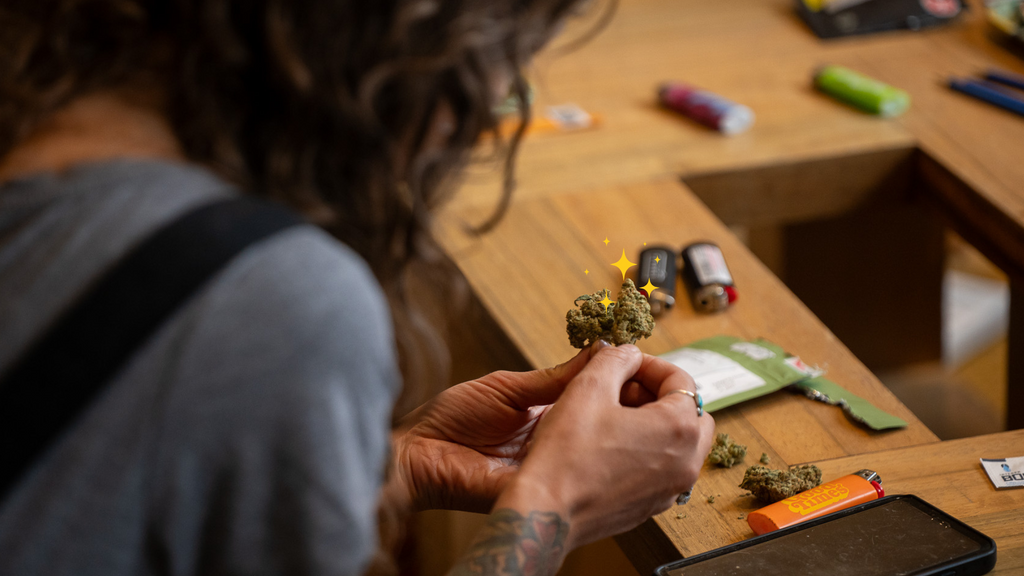
Bud Size To evaluate the Bud Size, we simply place our buds next to a lighter for size reference and then assess whether our buds are tiny, small, medium, big or huge.
For us, bud size indicates the artistic manufacturing, care and size of the buds, as it’s not easy to maintain a well-cured, huge bud through the processing and supply chain.
Bud Colour To evaluate the Bud Colour, we specifically assess the colour of the plant material (flowers & trim leaves) and not the stigmas (hairs on the buds). Evaluating the bud colour helps us to determine the health and age of the buds in front of us, as really old or unhealthy buds will be mostly pale, brown or amber-ish in colour, while really healthy and fresh buds will mostly have vibrant tones of green, purple or even pink.
Trim To evaluate the Trim of the buds, we pay close attention to the amount of individual trim leaves we can spot on the buds. Badly trimmed buds will be full of leaves, whereas perfectly trimmed buds will show barely any visible leaves. We do so because the trim leaves themselves carry fewer glandular trichomes and, therefore, have a lower phytochemical content than the tiny flowers that make up the buds. Consequently, the trim leaves only add unnecessary chlorophyll and weight to the buds.
Trichomes (Bud Grading)
Trichomes are the tiny resin glands that grow primarily on the bracts of the cannabis flowers and produce and store all of the plant’s phytochemicals in their “heads.”
The Trichome evaluation includes the following observables:
Trichome Visibility To evaluate the Trichome Visibility, we take a look at our buds to see how easily we can notice the trichomes on them. The trichomes on really frosty flowers will be easily visible from afar as the entire bud will appear frosty white. However, for lower-quality buds, the trichomes will be hardly visible even when looking at the flowers close-up.
We evaluate the trichome coverage to determine the potential amount of present phytochemicals. Because the trichomes produce and store all of the phytochemicals in their heads, the more trichomes we can see on a bud, the higher the phytochemical content of the buds should be.
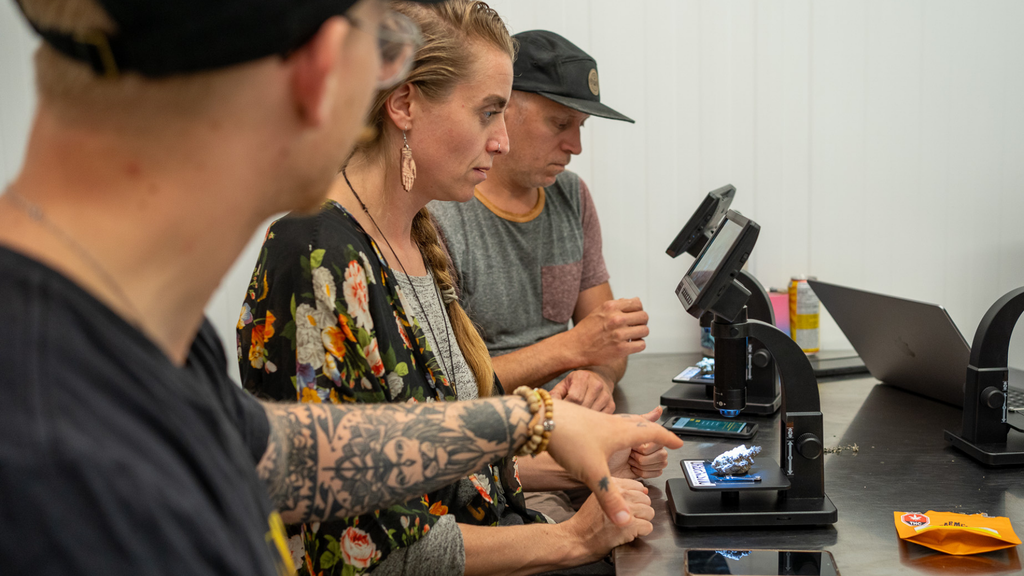
Trichome Colour To evaluate the Trichome Colour, we’re placing our buds under our digital microscope so we can have a close-up view of the individual trichome heads to assess their colour on the inside and the outside of the buds*. We evaluate the trichome colour because the colour of the trichome indicates the ripeness of the trichome heads and potential degradation of their phytochemical content. The colour range and change of trichomes are similar to the changing colours of fruit. A premature banana, for example, is often more light greenish and lacks its vibrant yellow colour before it fully matures. Similarly, premature trichomes appear translucent/clear in colour and turn into a glistening, milky white colour as they mature and fill up with phytochemicals. Further, like fruit that turns amber to brown as it degrades and starts to rot, trichomes also undergo a similar colour change and become more golden and then mostly amber and brown as the cannabis oxidizes and degrades.
Head Development To evaluate the Development of the Trichome Heads, we keep our buds under our digital microscope to have a close-up view of the size and robustness of our trichome heads on the buds’ inner and outer surface*. Because the entire intoxicating chemistry of cannabis is stored in the trichome heads, we evaluate the size and condition of the heads to assess how well the trichomes were maintained throughout the supply chain. Our fruit analogy also applies here as well to help us understand the importance of having proper trichome heads. We can think of the trichomes as apples, whereas our bud is the apple tree. Now, imagine you’re an apple farmer and have apple trees that lack apples or carry only little apples. That would be kind of frustrating as you’d want proper, large apples that would give you more yield, be more appealing to your customers, and help you make much more apple juice. The same idea applies to our cannabis farmers who are eager to produce buds full of big, robust trichomes that are able to carry higher amounts of phytochemicals, make the buds look more appealing to their customers and allow them to yield much more resin when being extracted.
*We evaluate the inner and outer surfaces of our buds to: A) Analyze the impact of the product packaging & handling on the integrity of the trichomes. B) Find possible undesirables like bud rot that could potentially be hidden inside the buds.
Undesirables
As we’re scoping our buds, we eventually can find undesirables like hairs, insects, moulds or seeds inside of them. The colour and shapes of the undesirables will stand out from the plant material and trichomes we can observe on the buds. Moulds like jar rot, for example, will look like white spider webs that cover the buds, while bud rot makes the inside of the buds appear brown and also shows some white webbing, whereas powdery mildew will appear like spots of white powder on the plant material. Insects and seeds will be easy to spot as the insects are easy to spot based on their dark colour, bodies and legs, and the seeds will appear as light brown ovals – coated by a white, translucent calyx membrane for micro seeds.
Curing (Bud Grading)
To evaluate the cure of our buds, we do a squeeze test by firmly squeezing the buds and watching how they react when we pinch them between our fingers. We do so to evaluate the moisture levels of our buds, as too much or too little moisture can negatively affect the consumption experience and other factors like the aroma. Poorly cured buds, for example, will be so dry that they crumble into pieces, while too-moist buds will stay squished. Well-cured buds, on the other hand, will either slightly or fully bounce back like a sponge.
Dry Pull Flavour (Smoke Grading)
The Dry Pull refers to tasting your joint before smoking it by taking a puff of the unlit (dry) joint.
The Dry Pull evaluation includes the following factors:
Dry Pull Intensity To evaluate the dry pull intensity, we take a few puffs of our joint before lighting it while assessing how much flavour we can notice. We evaluate the dry pull intensity to gauge the concentration of flavourful phytochemicals before we start combusting them. High-quality or really aromatic cannabis, for example, should have an intense dry pull that fills our entire taste buds with an intense flavour, while lower-quality cannabis has just a mild or even no dry pull flavour at all.
Dry Pull Complexity To evaluate the dry pull complexity, we take another few dry pulls after assessing the intensity, while we now shift our focus to evaluating the entire spectrum of flavours we notice. We evaluate the dry pull complexity to assess the variety of phytochemicals or potential undesirables that are present in our joint. Further, we use the complexity of the dry pull as a reference point to compare to our aroma complexity and the following smoke complexity evaluations, as high-quality cannabis should only have a minimal aroma-to-flavour variance that should be pleasant or complex overall.
Lower-quality cannabis, however, will have an unpleasant or faint flavour that matches the lack of aroma or has lost flavour compared to the buds’ initial pleasant fragrance.
Smoke Flavour (Smoke Grading)
To evaluate the smoke flavour, we assess the flavour complexity of the smoke within the first and last couple of puffs. We evaluate the smoke flavour at the beginning and the end of the joint to not only see how pleasant the joint tastes but also compare how well the flavour is retained throughout the entire consumption experience. High-quality cannabis, for example, will have a pleasant or complex flavour that maintains the initial complexities we picked up in the aroma and dry pull flavour and tastes well from the beginning to the end of the joint. In contrast, low-quality cannabis will either taste unpleasant or faint from the get-go or change from a more average to an unpleasant flavour towards the end of the joint.
Ash Colour (Smoke Grading)
To evaluate ash colour, we keep smoking our joint until about half is consumed and then let a bit of ash build up, which we then flick off to assess the ash colour right at the center of the ash cone. We evaluate the ash colour as a measurement that can show us the absence or presence of residuals – like moisture, undesirables, nutrients or chlorophyll – in our joint. Really clean cannabis will usually have a light grey to even fully white ash colour, while the ash colour of lower quality cannabis will be more dark grey or entirely black. However, we’d like to mention here that the reference of ash colour to cannabis quality is an extensive discussion amongst the cannabis community. Some individuals swear that a clean ash colour indicates a clean and properly flushed product, while others argue that the ash colour is irrelevant to the quality of your cannabis.
Our observations around this topic are that we’ve never smoked an entirely smooth and flavourful joint that burnt black, and neither did we ever smoke a fully clean burning joint that wasn’t smooth or flavourful. However, we agree that the ash colour is probably one of the least important aspects of the experience, but still evaluate it to do some proper data analysis in the future that lets us examine the correlation between ash colour, flavour and smoothness.
Smoothness (Smoke Grading)
To evaluate the smoothness, we assess what kind of sensation we can perceive in our throat when inhaling the smoke from our joint. We evaluate the smoothness to track how easy or harsh the cannabis is to consume. The best cannabis will be super smooth to smoke, meaning that we can barely sense any irritation in our throat or maybe just a slight tickle, while low-quality cannabis will burn our throat or dry it out, which causes our throat to hurt and constrict and causes an unpleasant or even painful sensation when we smoke our joint.
As we have now successfully covered all of the objective characteristics of cannabis quality, let’s talk about the subjective parts of cannabis quality: the Effects.
Experience: Quality vs Effects
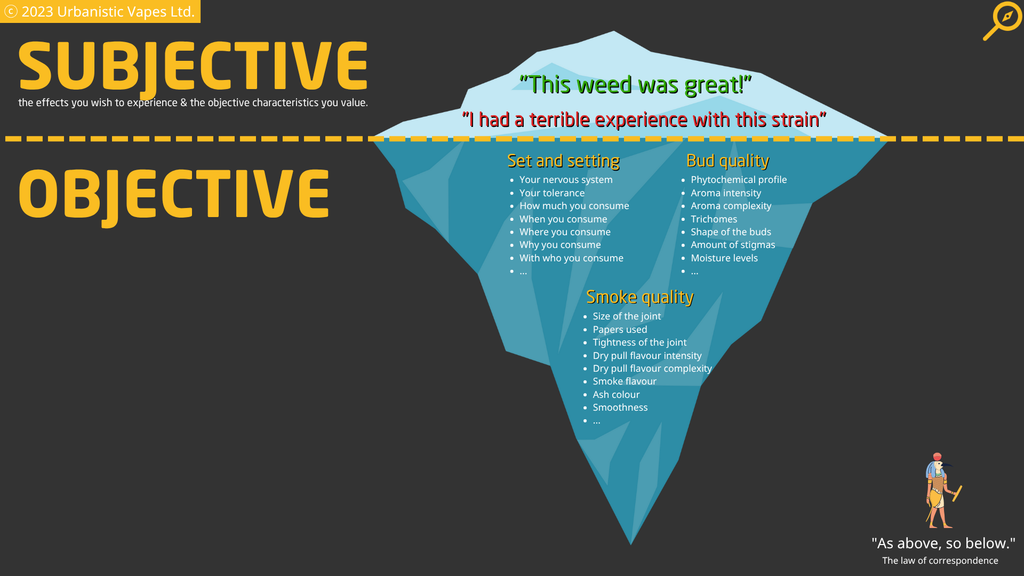
As I just said, we consider the Effects to be subjective parts of our cannabis experience, as the effects we get from consuming cannabis are dependent on the make-up of our individual endocannabinoid system, nervous system and overall well-being.
Let’s quickly talk about why that is.
Cannabis primarily affects our Endocannabinoid System, which is responsible for fine-tuning the Neurotransmission within our Nervous System.
Neurotransmission is the electrical and chemical communication between the 80 billion neurons in our nervous system that communicate through about 500 trillion synapses.
Reading this hopefully makes you think “damn, that sounds complex,” and you’re right, the nervous system – which includes our brain, limbs and organs – is literally the most complex system in the entire universe.
It is because of the complexity of the processes within this system and the countless number of possible states of our nervous system that Neuroscientists like Andrew Huberman say that you can’t predict what experience anyone is going to have after smoking cannabis.
Further, your nervous system is quite literally the most fundamental building block of your entire existence by enabling you to think, move, perceive and do literally anything. And because your nervous system is formed by your genetics and literally every experience you ever had, and has such an insane capability of variance, I think that no one besides yourself actually knows what your nervous system is like.
Therefore, it’s impossible for anyone to really know what it’s like to be you and what any drug will really do to you. In contrast, it’s much easier to agree that a bud smells or looks a certain way, as these criteria are much more objective to assess than what the complex mixture of phytochemicals will trigger within the vast network of 80 billion neurons.
However, this doesn’t mean that we can’t evaluate our individual effect experience. Quite the contrary. This is why we have to evaluate our individual cannabis experiences, and why even doctors and cannabis nurses make their patients evaluate how a certain type of product made them feel.
That being said, let’s dive into the Effect Grading System on our Grading Platform.
Our effect grading system allows you to assess how cannabis impacted various factors of your mental and physical well-being, including:
The Intensity of Intoxication
Your Energy Levels
Your Mood
Your Concentration
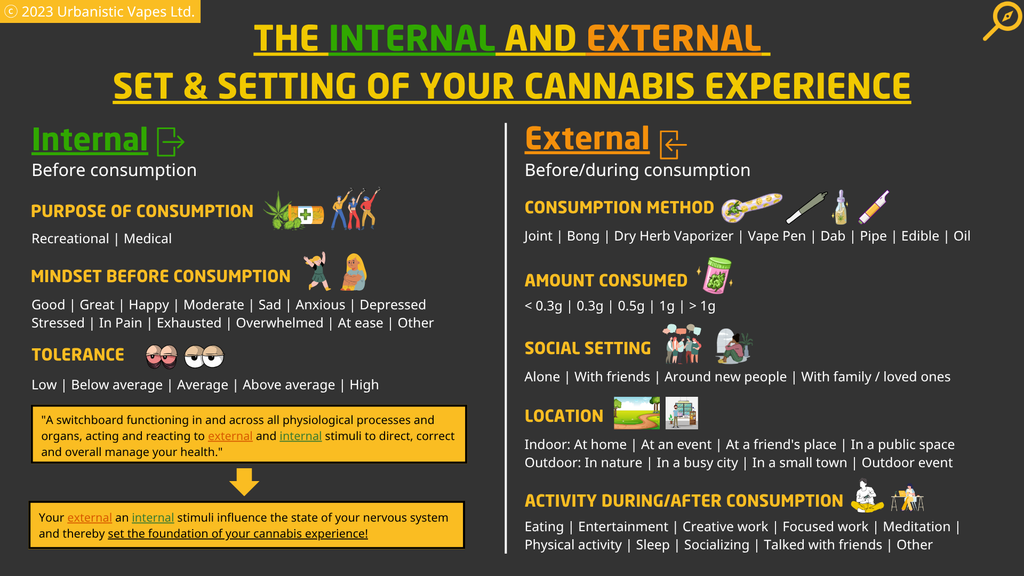
Besides these post-consumption factors, a proper effect evaluation should also assess your set and setting prior to and during consumption, as your set and setting have a big influence on the current state of your nervous system and your overall cannabis experience.
For the set and setting, we track:
Our purpose of consumption
Our mindset before consumption
Our consumption method
How much we consumed
Our Social setting
Our location
What activities we did during/after consuming
Lastly, at the end of the effect evaluation, we also rate our subjective experience overall on a scale of 1-5.
What’s interesting to mention here is that grading your cannabis quality and the effects you experience from various cannabis products will show you that there’s no objective way to understand cannabis, especially since the effects are highly individualistic.
What you can understand objectively are the various objective sensory characteristics we have discussed, which will empower you to ensure that someone’s consumption experience will be pleasant.
The effects, however, are unpredictable; you can take a guess, but that’s all you can really do when it comes to “recommending an experience.”
I, for example, have smoked very pleasant, high-quality buds that gave me a panic attack, while I also consumed more average weed that gave me the best time ever.
The more experience you gather by grading and recommending products, the more you’ll see how easy it is to evaluate quality and how impossible it is to predict what someone’s experience will be like.
At the end of the day, there’s good quality weed and there’s bad quality weed, but the weed that works the best for you is solely up to your individual neurochemistry.
So, keep grading and tracking experiences with our Sensemillier Grading Platform because that’s all you can really do to learn what type of cannabis works for you and what doesn’t.
PS: If a customer or friend comes up again to ask you what weed “makes them happy,” I recommend sending them this article so they see that’s not your job to know but theirs.
Ready to take your cannabis knowledge beyond THC percentages and strain names?
The Sensemillier program gives cannabis professionals a structured way to evaluate product quality, build sensory expertise, and learn how to assess cannabis more consistently and confidently. Create a free account on the Sensemillier Grading Platform and evaluate one or two products yourself. It’s the fastest way to see how structured grading can transform the way you understand cannabis.
Retail Managers: Want to bring structured grading to your store? Visit Sensemillier to explore the program and learn more.
When most Canadians think about the country’s role in cannabis, they think about legalization.
Canada was the first G7 nation to legalize adult-use cannabis, and for years that milestone has dominated the conversation. But according to industry leaders, Canada’s greatest cannabis success story may not be happening at home. It’s happening overseas.
Speaking at the Economic Club of Canada’s event Canada’s Next Global Advantage: Unlocking the Economic Power of Cannabis, Organigram CEO James Yamanaka highlighted Canada’s position as the world’s leading exporter of medical cannabis.
Canadian companies currently account for approximately 46% of cannabis exports to Germany, one of the largest medical cannabis markets in the world. When product routed through Portugal is included, Yamanaka estimates that Canadian companies may be responsible for as much as 60% of the German market.
For consumers, this is an important reminder that Canadian cannabis is recognized globally for its quality, consistency, and compliance standards. The products found on Canadian shelves come from an industry that is supplying patients around the world.
The Real Growth Story Is Medical Cannabis
While recreational cannabis receives most of the media attention, Yamanaka believes the largest international opportunities are currently found in medical markets. Germany, Australia, and the United Kingdom are among the fastest-growing medical cannabis jurisdictions, with Germany leading the way. Yamanaka estimates the German medical cannabis market is currently worth approximately €2.5 billion and growing at double-digit rates. Within the next two years, he believes it could reach €4.5 billion as patient numbers continue to rise.
This highlights an important reality: medical cannabis remains a major driver of global cannabis growth. While Canadian consumers often focus on recreational products, many international markets are building their cannabis industries through medical access programs first. Understanding cannabinoids, terpene profiles, dosage formats, and patient needs remains highly relevant knowledge, even in an adult-use environment.
Why Medical Cannabis Is So Difficult to Produce
One reason Canada has been successful internationally is that producing medical cannabis is significantly more demanding than producing cannabis for many recreational markets. Yamanaka compared medical cannabis production facilities to pharmaceutical clean rooms, where strict quality controls must be maintained from cultivation through packaging.
To access European markets, producers must meet rigorous standards such as EU-GMP certification, a system designed to ensure consistency, safety, and quality in medical products. This helps explain why not every producer can access international markets and why medical cannabis often commands higher prices. The barrier to entry is much higher than many consumers realize.
Success in global medical markets isn’t just about growing cannabis. It’s about demonstrating pharmaceutical-grade quality, consistency, testing, documentation, and compliance.
Competition Is Coming
Despite Canada’s current leadership position, Yamanaka cautioned that the country’s advantage is not guaranteed. Countries such as Thailand, Colombia, and South Africa are increasingly investing in cannabis production as they recognize the economic potential of supplying international medical markets.
According to Yamanaka, several well-funded companies in Thailand are already constructing sophisticated indoor cultivation facilities specifically designed to compete for European export opportunities. Canada’s head start has provided a valuable advantage, but other countries are working to close the gap.
“If Canadian companies don’t have the capital to invest, to automate, to expand, and to keep those advantages,” Yamanaka warned, “the Canadian companies will lose it.”
For anyone working in the industry, this is an important perspective. The cannabis industry is no longer competing only within provincial markets. Canadian producers are competing globally, and maintaining leadership will require continued investment in innovation, quality, automation, and research.
A Global Cannabis Leader
For years, cannabis discussions in Canada have focused on legalization, retail expansion, and domestic policy. Yet the industry’s future may be increasingly shaped by international trade.
Canada is currently one of the few countries that can claim true global leadership in cannabis production and exports. Canadian companies are supplying patients in some of the world’s fastest-growing medical markets and helping establish quality standards for the international industry.
The challenge now is maintaining that position.
For consumers, that’s something to be proud of. For budtenders, it’s a reminder that the products they sell every day are part of an industry that has become a global benchmark for medical cannabis quality. Canada may have legalized cannabis first, but its lasting legacy could be becoming the world’s pharmacy for medical cannabis.
For many Canadians, cannabis is still viewed primarily as a retail product or a social issue. Yet according to industry leaders, the legal cannabis sector has quietly become one of the country’s most significant economic contributors.
Speaking at the Economic Club of Canada’s event Canada’s Next Global Advantage: Unlocking the Economic Power of Cannabis, Organigram CEO James Yamanaka highlighted just how large the industry has become.
“The legal cannabis industry now employs probably close to a quarter of a million people,” Yamanaka said. He added that the sector contributes “about $16 billion” to the Canadian economy, including roughly “$8 billion” in direct GDP.
Those numbers place cannabis among Canada’s major industries.
To put this into perspective, moderator and Globe and Mail reporter Jameson Berkow noted that Canada’s oil sands and heavy oil sectors—often viewed as pillars of the Canadian economy—support approximately 200,000 direct and indirect jobs. The cannabis industry, by comparison, supports nearly 250,000 jobs across cultivation, processing, retail, logistics, research, compliance, marketing, and countless other roles. Yet despite its economic footprint, cannabis rarely receives the same recognition.
Yamanaka challenged this perception directly, asking, “What industry does Canada have where it is the world leader… the biggest exporter?” His point was simple: cannabis is no longer a niche market. It is one of the few industries where Canada can legitimately claim global leadership.
For budtenders, this matters. Every day, budtenders help consumers navigate products, understand cannabinoids, and make informed purchasing decisions. While the role is sometimes underestimated by those outside the industry, these economic figures demonstrate that budtenders are part of a sector that generates billions of dollars in economic activity and supports hundreds of thousands of Canadian jobs.
The numbers also matter for cannabis advocacy organizations. Public conversations about cannabis often focus on consumption, public health, or legalization policy. Those issues remain important, but economic impact is becoming an increasingly powerful part of the conversation.
When policymakers understand that cannabis supports nearly a quarter of a million Canadian jobs, contributes billions to GDP, and generates export revenue around the world, the industry becomes harder to dismiss as a fringe issue. It becomes an economic development story.
This shift in framing may be one of the industry’s greatest opportunities. Rather than focusing solely on cannabis as a regulated product, advocates can point to its role as a source of employment, innovation, tax revenue, and international trade.
As Yamanaka suggested, the future of cannabis advocacy may depend on helping Canadians recognize what the industry has already become: a major employer, a global exporter, and an important contributor to Canada’s economy.
Cannabis is one of Canada’s fastest-growing economic success stories.
For generations, potatoes have been one of Canada’s most iconic agricultural crops. They have shaped rural economies, supported farming communities, and become synonymous with agricultural production in provinces like New Brunswick and Prince Edward Island.
But according to Organigram CEO James Yamanaka, there is a new crop making an even larger economic impact in parts of Atlantic Canada.
Speaking at the Economic Club of Canada’s event Canada’s Next Global Advantage: Unlocking the Economic Power of Cannabis, Yamanaka noted that in New Brunswick, cannabis now generates more agricultural cash receipts than potatoes.
It’s a remarkable statistic. Less than a decade ago, cannabis was an illicit crop. Today, it has become one of the most valuable agricultural products in parts of Canada. The transformation reflects how quickly the legal cannabis industry has grown since legalization.
Across the country, the legal cannabis sector now supports nearly 250,000 jobs and contributes approximately $16 billion to the Canadian economy. Cultivation facilities, processing plants, laboratories, logistics networks, retailers, and ancillary businesses have created thousands of employment opportunities in communities large and small.
For many Canadians, cannabis is still viewed primarily through the lens of legalization or retail sales. Yet increasingly, cannabis is becoming an agricultural and economic story.
Like other high-value crops, cannabis requires skilled growers, sophisticated production facilities, research and development, quality assurance programs, and export infrastructure. Unlike many traditional crops, however, cannabis has also positioned Canada as a global leader in a rapidly growing international market.
The comparison to potatoes is more than just a surprising headline. It highlights how cannabis has evolved into a legitimate agricultural commodity capable of generating significant economic activity.
For budtenders, this perspective is important. Every product on a dispensary shelf represents the work of cultivators, processors, researchers, quality assurance teams, transportation providers, and countless other professionals. Retail is only one part of a much larger industry ecosystem.
For consumers, the statistic offers a glimpse into how deeply cannabis has become integrated into Canada’s economy. What was once a prohibited crop is now helping support jobs, generate tax revenue, drive exports, and strengthen regional economies.
The cannabis industry may benefit from being viewed less as a policy issue and more as an economic success story. And few statistics illustrate that transformation better than this one: in parts of Canada, cannabis has become bigger than potatoes.
For years, cannabis tourism was easy to explain. You went to Amsterdam. Or Jamaica. Today, things are way more exciting. Legalization, decriminalization, social clubs, and cannabis-friendly experiences have expanded travel destinations for stoners. A cannabis vacation can include exploring immersive art installations in Denver, joining a social club in Barcelona, or touring a pot farm in Jamaica.
The challenge isn’t finding somewhere cannabis-friendly anymore. It’s deciding what kind of cannabis traveler you want to be. Are you travelling for cannabis culture? History? Outdoor adventure? Luxury experiences? Beach vibes? Art? Music?
Fortunately, there’s a destination for all of the above.
Denver, Colorado
Stoner Surrealism and Art
One of the most culturally significant unique attractions in Denver is the International Church of Cannabis. Originally a church built in 1902, it was transformed into into a psychedelic light and art experience after legalization. Massive murals explode across the walls and ceiling while immersive light shows turn the sanctuary into something between an art gallery and an alternate dimension. Less religious institution, more sensory architecture experiment.
A few miles away sits Meow Wolf’s Convergence Station, arguably one of the most cannabis-compatible attractions on the planet. Visitors can spend hours navigating hidden passages, strange alien worlds, and bizarre storylines that make perfect sense right up until they don’t. You will regret not visiting Meow Wolf for the rest of your life if you skip it. 100% life changing immersive experience.
Denver also offers cannabis-friendly comedy nights, painting classes, educational cultivation tours, and an increasing number of social consumption spaces. When you’re finished exploring the city, Red Rocks Amphitheatre is less than an hour away. Seeing a concert surrounded by towering red sandstone formations is a bucket-list experience.
Cannabis Laws: Adult-use cannabis is legal in Colorado for 21+, with regulated dispensaries throughout Denver, though public consumption remains prohibited.
Don’t Miss: 📍 International Church of Cannabis 📍 Meow Wolf Convergence Station 📍 Red Rocks Amphitheatre (off-site consumption only) 📍 Cannabis cultivation tours 📍 Cannabis-friendly events and lounges 📍 Private 420-friendly events
Barcelona, Spain
The Social Club Capital
Barcelona’s cannabis scene operates by entirely different rules. There are no flashy dispensaries. No giant cannabis stores. No neon signs. Instead, cannabis culture lives behind unmarked doors. Cannabis social clubs emerged from Spain’s unique legal framework after court rulings interpreted private cultivation and consumption as non-criminal when conducted within closed groups. Rather than functioning as retail stores, these clubs operate as private associations where members can gather, socialize, and consume cannabis.
The result is a system that is neither commercial like North America nor fully prohibited like much of Europe. Some clubs are simple and low-key. Others host art exhibitions, live music, educational events, and social gatherings.
Outside the clubs, Barcelona remains one of Europe’s most captivating summer destinations. Antoni Gaudí’s surreal architecture seems almost designed to bend reality. The winding streets of the Gothic Quarter invite endless wandering. Barceloneta Beach provides relief from the summer heat, while tapas bars keep the city buzzing long after midnight.
Cannabis Laws: Public consumption is illegal. Private consumption is generally tolerated. Cannabis social clubs operate through membership systems, but they are not retail dispensaries and are tightly regulated at the municipal level. Public consumption can result in fines.
Don’t Miss: 📍Cannabis social clubs 📍Park Güell 📍Sagrada Família 📍Gothic Quarter 📍Barceloneta Beach
Amsterdam, Netherlands
The Original Cannabis Pilgrimage
While many destinations now offer legal cannabis, none can replicate the history of Amsterdam. Long before legalization became politically acceptable, Amsterdam’s coffeeshop culture created a space where cannabis consumers could gather openly. The city’s reputation became so intertwined with cannabis that many travellers still assume it is the world’s cannabis capital.
What surprises first-time visitors is how much more Amsterdam offers beyond coffeeshops. The city is built for slow exploration. Canal cruises drift past centuries-old buildings. Bicycles outnumber cars. Parks fill with locals enjoying the short Dutch summer. Every corner seems to contain another café, gallery, or hidden courtyard.
For cannabis enthusiasts, the city’s greatest attraction may actually be its history. Amsterdam isn’t simply cannabis-friendly. It helped normalize cannabis culture for generations of travellers. What matters is not the legal nuance, but the cultural precedent: Amsterdam proved cannabis could exist in open, regulated hospitality environments without collapsing public order.
Cannabis Laws: The Netherlands never fully legalized cannabis. Instead, it developed a tolerance policy that allows licensed coffeeshops to sell small quantities Cannabis remains technically illegal but is tolerated under Dutch policy (“gedoogbeleid”) through these licensed coffeeshops under strict limits. Cultivation, production, and supply chains remain illegal, creating a regulated-but-contradictory system.
Don’t Miss: 📍 Historic “coffeeshops” 📍 Cannabis museum and counterculture history 📍 Canal cruises with cannabis-friendly etiquette (private use rules apply) 📍 Vondelpark 📍 Jordaan neighbourhood
Jamaica
Beyond the Stereotypes
No destination suffers from more cannabis clichés than Jamaica. Images of reggae music, beach chairs, and oversized spliffs have become so common that they often overshadow the island’s actual cannabis culture.
Jamaica offers one of the most culturally rooted cannabis experiences in the world. Cannabis in Jamaica is deeply connected to Rastafarian spirituality, cultural identity, and historical resistance. For travellers interested in learning rather than simply consuming, Jamaica offers one of the most meaningful cannabis experiences available.
Cannabis here (traditionally known as “ganja”) is deeply tied to Rastafarian spiritual practice and historical resistance movements. Visitors can tour cannabis farms, visit herb houses, meet local cultivators, and learn about the plant’s role within Jamaican society.
Of course, there are also magnificent beaches. Whether you’re exploring Negril’s famous Seven Mile Beach or chasing waterfalls near Ocho Rios, Jamaica effortlessly combines cultural education with tropical vacation energy.
Cannabis Laws: Decriminalization in 2015 reduced penalties for small possession and created a framework for medical and religious use, though full legalization has not occurred.
Don’t Miss: 📍 Cannabis farm tours in rural parishes 📍 Herb houses 📍 Rastafarian cultural experiences 📍 Seven Mile Beach 📍 Dunn’s River Falls 📍 Cultural education around ganja and spirituality
Vancouver, Canada
Cannabis Meets the Great Outdoors
Some destinations build attractions around cannabis. Vancouver doesn’t need to. The city’s greatest asset is its setting, at the base of a mountain surrounded by ocean, forests, and islands.
Cannabis has been legal across Canada since 2018, and Vancouver’s cannabis scene has matured into something refreshingly normal. Dispensaries aren’t tourist attractions. They’re simply part of the landscape. That freedom allows visitors to focus on the city itself.
Spend the morning cycling around Stanley Park. Grab lunch at Granville Island. Kayak through False Creek. Watch the sunset over English Bay. Take a day trip to Vancouver Island. Take a trip to all the islands! The cannabis is there when you want it.
Cannabis Laws: Cannabis is legal nationwide for adults, though public consumption regulations vary. There are very strict no smoking laws in public places including Granville Island.
Don’t Miss: 📍 Stanley Park 📍 Granville Island 📍 English Bay 📍 North Shore hiking trails 📍 Vancouver Island
Montevideo, Uruguay
A Cannabis History Lesson
Uruguay rarely appears on mainstream travel lists, which is precisely why it deserves attention. In 2013, the country became the first nation in the world to legalize cannabis. While Canada’s market eventually became larger and American legalization attracted more headlines, Uruguay changed the conversation first.
Its system wasn’t designed around tourism or corporate profits. Instead, legalization was approached as a public policy experiment intended to undermine illicit markets and improve public health outcomes. For cannabis enthusiasts, visiting Uruguay is like visiting a historical landmark. You’re seeing the place that proved nationwide legalization was possible.
The capital city of Montevideo adds beaches, historic architecture, wine regions, and a relaxed atmosphere that feels worlds away from the pace of larger tourist destinations.
Cannabis Laws: Legal nationwide, but access is structured primarily for citizens and registered residents. Tourism access is extremely limited.
Don’t Miss: 📍 Cannabis policy history 📍 Ciudad Vieja 📍 Rambla waterfront walking culture 📍 Montevideo cultural and coastal exploration
Berlin, Germany
Europe’s New Cannabis Frontier
Germany’s recent cannabis reforms have made Berlin one of the most closely watched cannabis destinations in Europe. The city already possessed a strong counterculture identity, legendary nightlife, and a long history of alternative communities. Cannabis reform simply added another layer.
Berlin’s appeal lies in its unpredictability. One moment you’re exploring remnants of the Berlin Wall. The next you’re wandering through a street art-covered neighbourhood or dancing until sunrise in a converted industrial building. As Germany continues navigating its evolving cannabis landscape, Berlin is positioned to become one of Europe’s most important cannabis destinations.
Cannabis Laws: Germany allows personal possession and limited cultivation under federal rules, with cannabis clubs operating under regulatory frameworks. Commercial retail is still restricted.
Don’t Miss: 📍 East Side Gallery 📍 Kreuzberg 📍 Museum Island 📍 Berlin nightlife
Bangkok, Thailand
Cannabis Tourism’s Wild Card
No destination has experienced a cannabis transformation quite like Thailand. Within a remarkably short period, dispensaries appeared throughout Bangkok, cannabis cafés emerged, and the country became one of the most talked-about destinations in global cannabis tourism.
At the same time, Thailand’s regulations have continued evolving, creating an environment where travellers should pay close attention to current laws before visiting. Even without cannabis, Bangkok is sensory overload in the best possible way. Night markets, floating markets, temples, rooftop bars, and street food create an experience unlike anywhere else.
Cannabis Laws: Regulations continue to evolve. Travelers should verify current rules before departure.
Don’t Miss: 📍 Cannabis cafés 📍 Night markets 📍 Temple tours 📍 Rooftop dining 📍 Chao Phraya River cruises
Portland, Oregon
Where Craft Cannabis Thrives
If California helped build the cannabis industry, Oregon perfected the craft side of it. Portland has long embraced independent businesses, local makers, and a fiercely DIY culture. The city’s cannabis scene reflects that same mindset. Here, cannabis isn’t treated as a luxury product or a tourist attraction. It’s approached more like craft beer, specialty coffee, or small-batch wine, as something to be discussed, compared, and appreciated.
Oregon is known for producing exceptional flower, and many cannabis enthusiasts consider the state one of North America’s premier destinations for terpene-rich cultivars and small-scale cultivation. Step into a Portland dispensary and you’re likely to find knowledgeable staff eager to discuss genetics, growing techniques, and flavour profiles.
Outside the dispensaries, Portland offers plenty of ways to spend a summer day. Forest Park contains more than 80 kilometres of trails within city limits, making it one of the largest urban forests in North America. Food trucks serve everything from Korean fried chicken to handmade dumplings, while local breweries, bookstores, and quirky neighbourhoods reward wandering without a plan.
A short drive outside the city opens up even more possibilities. The Columbia River Gorge offers waterfalls, hiking trails, and breathtaking viewpoints, while the Oregon coast delivers rugged beaches and dramatic ocean scenery that feel a world away from urban life.
Unlike destinations that have built tourism attractions around cannabis, Portland’s appeal comes from how naturally cannabis fits into the city’s culture. It’s less about spectacle and more about appreciation, making it a destination for travellers who enjoy learning about what they’re consuming and the people who produce it.
Cannabis Laws: Adult-use cannabis is legal for adults 21 and older. Purchases can be made through licensed dispensaries, though public consumption remains prohibited.
Don’t Miss: 📍 Boutique dispensaries featuring Oregon-grown flower 📍 Food cart pods 📍 Powell’s City of Books 📍 Tillamook Cheese 📍 Oregon Coast day trips
Today, cannabis travel is wildly diverse. Some places offer fully legal retail markets. Others operate through private clubs, pilot programs, or decriminalized frameworks. A few still sit in legal grey zones where culture has outpaced legislation.
The question isn’t where can I go? It’s what kind of cannabis culture do I want to experience?
If you’ve spent any time browsing dispensary menus lately, you’ve probably seen products described as THC diamonds, diamond-infused pre-rolls, or diamonds and sauce. The name sounds more like something you’d find in a jewellery store than a cannabis shop, but diamonds have quickly become one of the most popular and potent cannabis products on the market. So what exactly are THC diamonds, and why are they showing up in everything from concentrates to pre-rolls?
What Are THC Diamonds?
Despite the name, cannabis diamonds aren’t actually made of THC. They are made of THCA (tetrahydrocannabinolic acid), the natural compound found in raw cannabis plants that eventually becomes THC.
THCA itself does not produce the intoxicating effects associated with cannabis. However, when heat is applied through smoking, vaping, or dabbing, THCA converts into THC through a process called decarboxylation.
Think of THCA as the inactive version of THC. Once heated, it transforms into the cannabinoid responsible for the euphoric and intoxicating effects that consumers experience. THCA diamonds are called “diamonds” because they form into crystal-like structures that can look remarkably similar to tiny gemstones.
Why Are Diamonds So Potent?
What makes diamonds unique is their purity. Most cannabis flower contains between 15% and 30% THC. By comparison, THCA diamonds often test between 97% and 99% THCA, making them one of the most concentrated cannabis products available.
Because they contain almost pure cannabinoid content, even a very small amount can have a significant effect once heated and converted into THC.
How Are THC Diamonds Made?
Diamonds start with cannabis flower, specifically the sticky resin glands called trichomes that contain cannabinoids and terpenes. Most producers begin with fresh-frozen cannabis, meaning the plant is harvested and immediately frozen to preserve its cannabinoid and terpene profile.
Using specialized extraction equipment, cannabinoids and terpenes are separated from the plant material. Over time, under carefully controlled conditions, the THCA naturally begins to crystallize and form solid structures. These crystals become the diamonds. The liquid portion left behind is rich in terpenes and is commonly called sauce. When sold together, the product is often labelled as diamonds and sauce.
What Are “Diamonds and Sauce”?
If you’ve ever opened a jar of diamonds and sauce, you’ll notice two distinct components:
The diamonds are the solid THCA crystals. The sauce is a terpene-rich liquid containing flavour and aroma compounds.
This combination gives consumers the best of both worlds: Extremely high potency from the diamonds. Rich flavour and aroma from the terpene sauce.
On their own, diamonds have very little flavour or smell. The sauce is what provides the strain-specific aromas consumers often associate with premium cannabis products.
How Are THC Diamonds Consumed?
There are several ways consumers use diamonds.
Dabbing Dabbing remains one of the most common methods. A small piece of diamond is placed on a heated surface and vaporized for inhalation. Because diamonds are so potent, most consumers only need a tiny amount.
Concentrate Vaporizers Many modern concentrate vaporizers and electronic dab rigs are designed specifically for products like diamonds. These devices allow users to control temperature, helping preserve flavour while activating the THCA.
Adding Diamonds to Flower Some consumers crush diamonds and sprinkle them onto flower before smoking. This can significantly increase the potency of a bowl, bong, or joint.
Diamond-Infused Pre-Rolls One of the fastest-growing cannabis categories is the diamond-infused pre-roll. Manufacturers mix crushed diamonds into the flower or apply them to the outside of the pre-roll to create a stronger experience than traditional flower alone.
Why Are Diamonds Becoming So Popular?
Several factors have contributed to the rise of diamond products.
1.High Potency Many experienced consumers seek products with higher cannabinoid levels, and diamonds deliver some of the highest concentrations available.
2. Consistency Because diamonds are highly refined, producers can more accurately control potency and dosing across products.
3. Versatility Diamonds can be used in concentrates, vape cartridges, infused pre-rolls, and other premium cannabis products.
4. Premium Appeal The crystal-like appearance and advanced extraction process have helped position diamonds as a high-end cannabis ingredient.
Are THC Diamonds Right for Everyone?
Not necessarily. While diamonds can be an enjoyable option for experienced consumers, they may be overwhelming for those who are new to cannabis or who typically consume lower-potency products. Because diamonds contain such high concentrations of cannabinoids, it’s important to start with a very small amount and assess how you feel before consuming more.
This is especially important with diamond-infused pre-rolls, which can deliver considerably more THC than a standard joint.
The Bottom Line
THC diamonds are actually THCA diamonds or highly purified cannabis crystals that convert into THC when heated. They represent some of the most potent cannabis products available and have become a popular ingredient in concentrates, vape products, and infused pre-rolls.
While the name may sound flashy, the science behind diamonds is straightforward: they’re simply an extremely refined form of cannabis extract designed to deliver purity, potency, and consistency.
If you’re exploring concentrates for the first time or curious about that diamond-infused pre-roll on the shelf, understanding what diamonds are, and how they work, can help you make a more informed decision on how potent you want your experience the next time you visit your local dispensary.
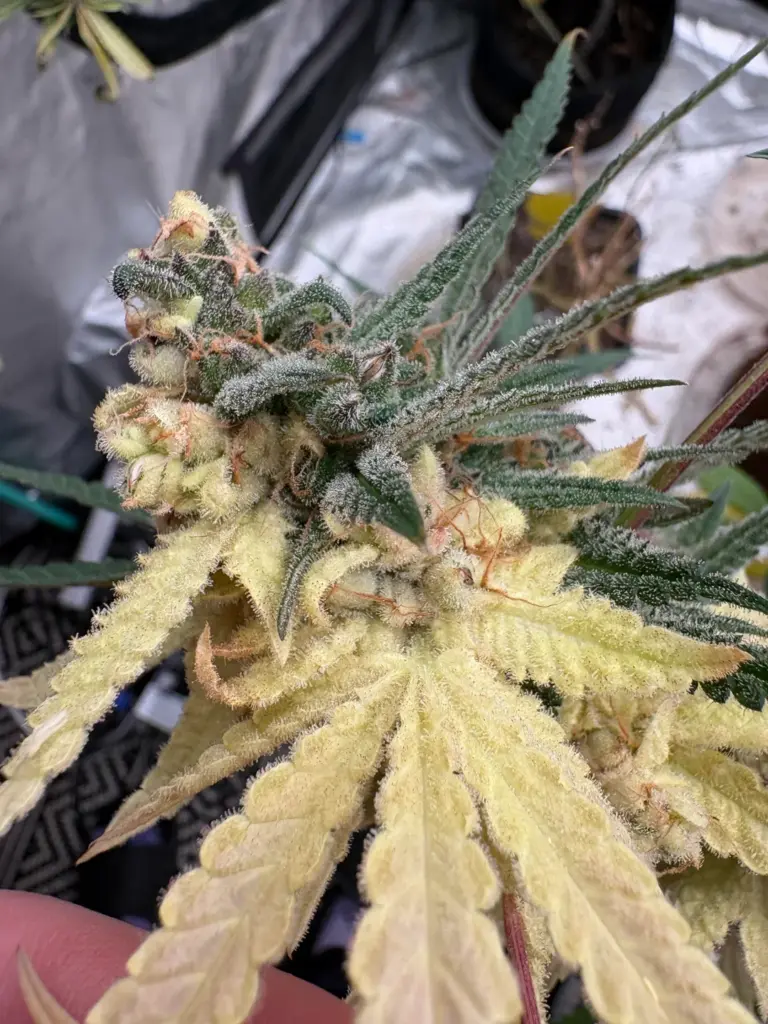
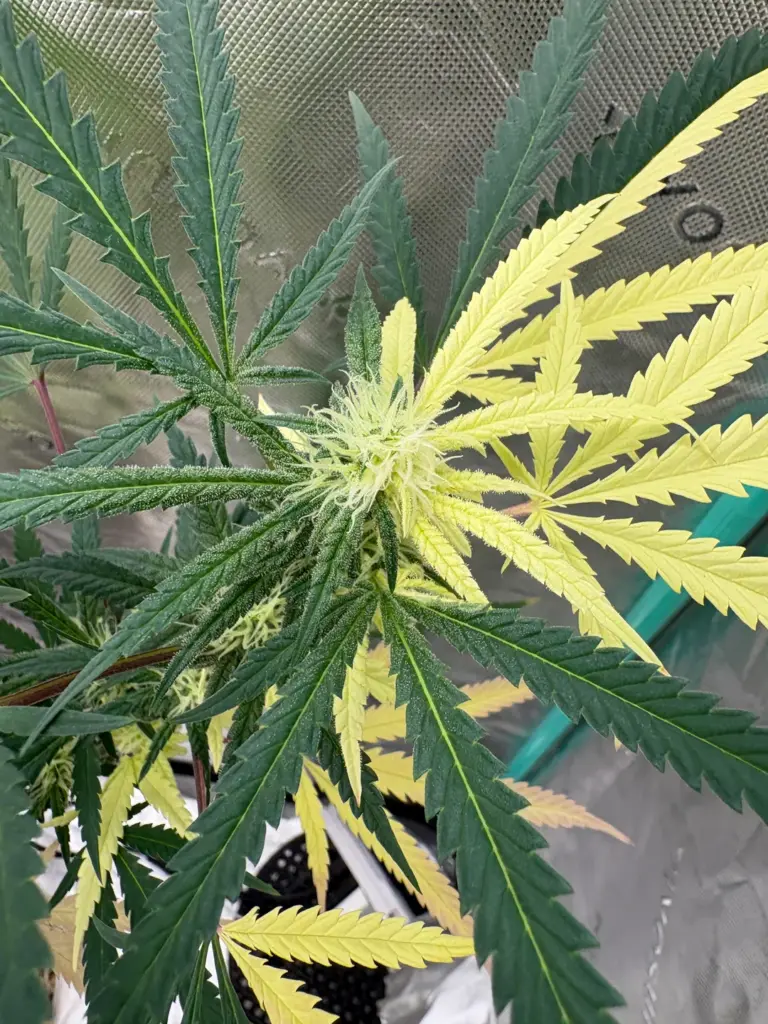
Every so often, a cannabis plant appears that seems almost impossible. A leaf split perfectly down the middle with one half emerald green, the other pure white. A cola spiralling upward with streaks of cream, lime, and forest green like a candy cane. In the rarest cases, entire leaves or flower emerge completely white.
These plants are known as variegated cannabis, and they are among the rarest natural traits in cannabis cultivation.
While variegated houseplants have become highly sought after by collectors, variegation in cannabis remains uncommon and often short-lived. Many heavily variegated plants struggle to survive, and some never make it through a full flowering cycle.
So what causes cannabis to lose its green colour? The explanation begins with one of the most important molecules in the plant kingdom: chlorophyll.
What Is Variegation?
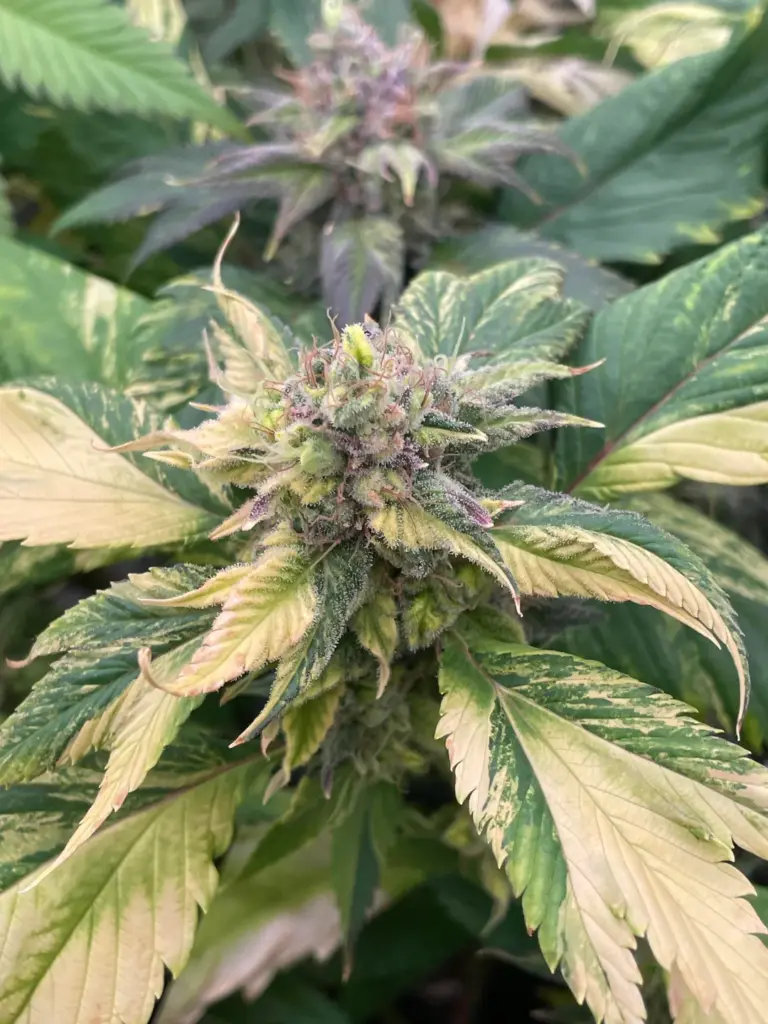
Unlike purple cannabis, which gets its colour from pigments such as anthocyanins, variegation is not simply a colour trait. It is the result of a genetic or cellular mutation that affects the plant’s ability to produce chlorophyll.
Chlorophyll is the green pigment responsible for photosynthesis. It allows plants to capture sunlight and convert that energy into the sugars needed for growth, development, and reproduction.
Most cannabis plants produce chlorophyll throughout their leaves and stems, creating the familiar green appearance associated with healthy plant growth. Variegated plants contain tissues where chlorophyll is reduced or completely absent. Because the green pigment is missing, these areas appear white, cream, yellow, or pale green.
In cannabis, variegation can appear as:
White streaks running through leaves
Half-white, half-green fan leaves
Marbled or mottled patterns
White sectors on stems
Occasionally, white sections within flowers
The white portions are not a separate pigment. They are areas where chlorophyll-producing cells are absent or defective. The result is striking. Some leaves develop random splashes of white, while others emerge with perfectly symmetrical patterns.
What Causes Variegation?
Most cases of true variegation originate from mutations affecting chloroplast development. Chloroplasts are specialized structures within plant cells where photosynthesis takes place. They contain chlorophyll and serve as the plant’s solar power stations.
If a mutation prevents chloroplasts from developing properly, those cells lose their ability to produce chlorophyll. As the plant grows, normal cells and mutated cells continue dividing side by side, creating distinct green and white regions throughout the plant.
In many cases, botanists describe these plants as chimeras. A chimera contains multiple genetically distinct cell populations within the same organism. Different parts of the plant are effectively operating under different genetic instructions.
Because these cell populations expand independently as the plant grows, the resulting patterns can be highly unpredictable. One branch may remain entirely green while another develops dramatic striping. No two leaves may look exactly alike. This unpredictability is one of the reasons variegated plants are so fascinating.
Most Variegated Cannabis Plants Struggle
The white portions of a variegated plant may be beautiful, but they come at a cost. Unlike green tissue, white tissue contributes little or nothing to photosynthesis. It consumes energy without producing much of it. A useful analogy is a solar panel array where half the panels are no longer functioning. The system can still operate, but overall efficiency drops significantly.
The green portions of a variegated cannabis plant must support the white portions. As a result, heavily variegated plants often display:
Slower growth
Reduced vigour
Smaller root systems
Lower biomass production
Increased sensitivity to environmental stress
Plants with modest amounts of variegation can often survive because enough green tissue remains to generate the energy needed for growth. As the percentage of white tissue increases, survival becomes more difficult. From an evolutionary perspective, variegation is generally a disadvantage. Plants that produce more chlorophyll are typically better at capturing energy and reproducing.
Completely White Cannabis Plants Rarely Survive
Every so often, photographs surface online showing nearly all-white cannabis seedlings or branches. While visually impressive, these plants are usually living on borrowed time as a completely white plant contains little or no functional chlorophyll. Without photosynthesis, energy reserves are quickly exhausted.
Unless sufficient green tissue exists elsewhere on the plant to support growth, the plant will eventually die. This is why truly albino cannabis plants are extraordinarily rare. Many germinate but fail to progress beyond the seedling stage. Others survive briefly before growth stalls entirely.
For a heavily variegated cannabis plant to reach maturity, enough green tissue must remain to power the entire organism.
Nature’s Spiral
One of the most fascinating aspects of variegation is that it can reveal growth patterns that normally go unnoticed. Cannabis follows a highly organized growth arrangement known as phyllotaxis. As new leaves, branches, and flowers develop, they emerge around the stem in a spiral pattern. This arrangement helps maximize light exposure while reducing self-shading.
Normally, this architecture is hidden because all tissues share the same green colour. Variegation can make these developmental pathways visible.
When a mutation occurs within a particular layer of cells in the growing tip, that cell line continues dividing as the plant expands. The result can be a stripe of white tissue that spirals around the stem, extends through leaf petioles, and continues into new growth. In some rare specimens, white and green bands appear to twist around each other as the plant grows, tracing the plant’s underlying structure like a living map. What initially appears random is often revealing the hidden geometry that exists within every cannabis plant.
Can Cannabis Flowers Become Variegated?
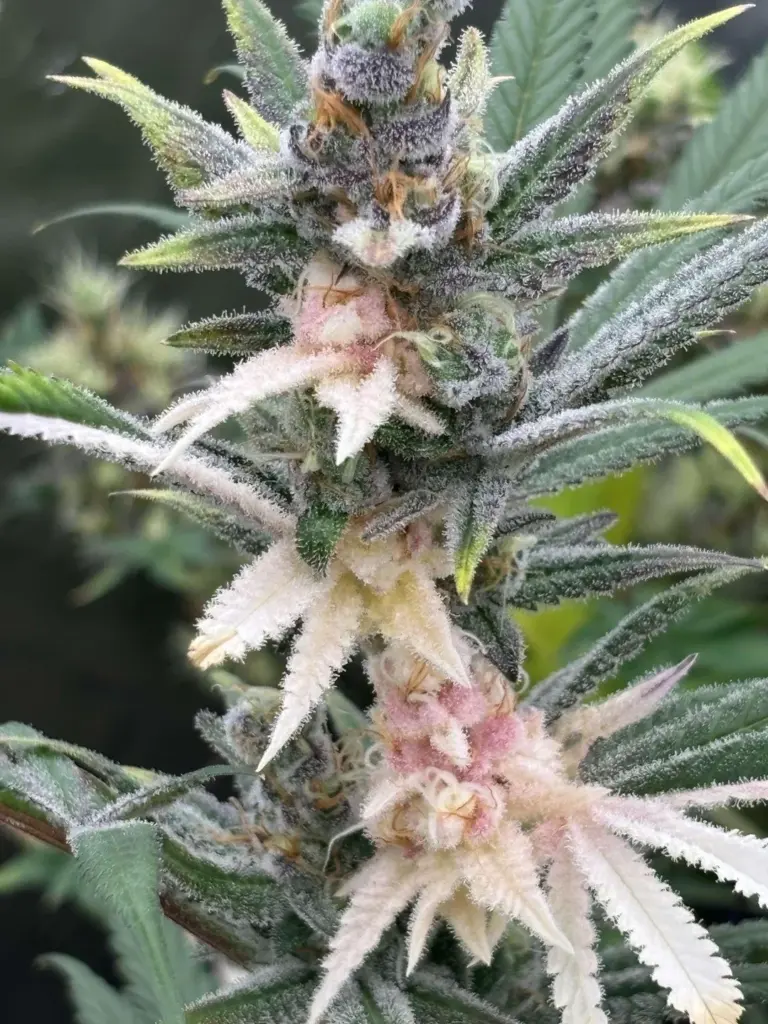
Yes, although flower variegation is significantly rarer than leaf variegation. Cannabis flowers develop from the same growing tissues responsible for leaves and stems. If variegated cell lines remain active during flowering, white sectors can appear within the buds themselves. This may produce:
White sugar leaves
Cream-coloured calyxes
Striped floral tissue
Mixed green and white sections within a flower
Because flowering is already one of the most energy-intensive stages of the plant’s life cycle, extensive variegation can place additional stress on the plant. As a result, many heavily variegated plants never reach the stage where these unusual flowers fully develop.
Why Growers and Consumers Find Variegation So Fascinating
Variegated cannabis plants are not necessarily stronger, more potent, or more productive than their green counterparts. In fact, they are often less vigorous and more difficult to cultivate. However, they provide a glimpse into the incredible complexity of plant genetics and development. They show how a tiny mutation can transform an ordinary cannabis plant into something extraordinary. They reveal hidden growth patterns. And they remind us that even after decades of cultivation and breeding, cannabis plants still have the ability to surprise us.
These botanical unicorns may struggle to survive, but when they do, they offer one of the most remarkable mutations found anywhere in the plant kingdom.
Here are some great examples of variegated cannabis from Reddit User UnStabE:
If you’ve spent any time around growers, breeders, or cannabis trade shows lately, you’ve probably heard the word triploid come up more than once. Unlike some industry buzzwords that appear overnight and disappear just as quickly, triploids represent a genuine advancement in plant breeding that could have a significant impact on how cannabis is cultivated in the future. But what exactly is a triploid cannabis plant, and why are so many people excited about them?
First, a Quick Genetics Lesson
Most cannabis plants are diploid, meaning they have two sets of chromosomes (one inherited from each parent). This is a very normal genetic structure we find in most plants we interact with every day. Triploid plants, on the other hand, have three sets of chromosomes instead of two.
This isn’t genetic modification or laboratory engineering. Triploids occur naturally throughout agriculture and have been used for decades in crops such as seedless watermelons and bananas. Plant breeders create triploids by crossing a diploid plant with a tetraploid plant, which contains four sets of chromosomes. The resulting offspring inherit three chromosome sets and become triploid.
The concept sounds simple (-ish lol), but those extra chromosomes can create some very interesting characteristics.
Why Are Cannabis Growers Interested?
The biggest reason triploids are attracting attention in cannabis is their potential to reduce seed formation.
To understand why this matters, it helps to understand how cannabis reproduces. When pollen reaches a female cannabis flower, the plant redirects energy toward producing seeds. For commercial flower producers, seeds are super undesirable because consumers expect dense, seed-free buds.
Triploid plants have difficulty producing viable reproductive cells because their chromosome sets do not divide evenly during reproduction. As a result, they can be significantly less likely to produce seeds when exposed to pollen.
Notice the wording there: less likely, not impossible.
One of the biggest misconceptions surrounding triploid cannabis is that it is completely sterile. In reality, sterility exists on a spectrum. While triploids can dramatically reduce seed production, they should not be viewed as an absolute guarantee against pollination under all conditions. Still, the potential reduction in seed formation has growers paying attention.
The Problem Triploids Are Trying to Solve
Cannabis cultivation has always faced a unique challenge: pollen travels. A single male plant, a rogue hermaphrodite, or pollen drifting in from a neighbouring field can create headaches for commercial cultivators. Outdoor growers face this risk every season, while greenhouse and indoor operators spend considerable resources preventing accidental pollination.
As the hemp and cannabis industries continue to expand, concerns about pollen contamination have only grown. In regions where multiple cannabis operations exist within close proximity, growers are increasingly interested in genetics that can help reduce the consequences of unwanted pollination.
Triploids offer one potential solution.
If a plant is less capable of producing mature seeds after pollination, growers may experience less quality loss and fewer seeded plants. For large-scale commercial operations, even a modest reduction in seed formation could translate into meaningful economic benefits.
Are Triploids More Potent?
This is where the conversation gets a little more complicated. Some people have assumed that triploid cannabis automatically produces higher cannabinoid levels, larger flowers, or dramatically increased yields. At this stage, the science does not support making broad claims like that.
Triploidy itself does not magically create more THC, more terpenes, or bigger harvests.What it can do is influence how a plant grows.
In other agricultural crops, triploids have sometimes demonstrated increased vigour, larger cell size, and unique growth characteristics. Whether those traits translate consistently across cannabis cultivars is something breeders are still actively exploring.
The reality is that a triploid plant is only as good as the genetics used to create it. A poorly selected triploid won’t outperform an exceptional diploid simply because it has an extra chromosome set.
For now, most of the excitement centres on reproductive characteristics rather than promises of record-breaking potency.
Why Consumers Should Care
At first glance, triploids might seem like a topic only breeders and commercial cultivators need to understand. But consumers could eventually benefit as well! If triploid genetics help growers produce more consistent crops with fewer seeds, that could contribute to improved flower quality and reduced production losses. Greater crop reliability may also help cultivators operate more efficiently, which benefits the broader supply chain.
For consumers who enjoy learning about cannabis genetics, triploids also represent another example of how sophisticated modern breeding has become. The cannabis industry has evolved far beyond simply crossing two popular strains together. Today’s breeders are applying advanced agricultural techniques that have been used successfully in food crops for generations.
Why They’re Becoming a Major Topic Now
Triploids have existed in agricultural science for a long time, but cannabis research has historically lagged behind other crops due to legal restrictions. As legal cannabis markets mature, breeders now have greater opportunities to invest in long-term genetic development. Research programs are expanding, breeding techniques are becoming more sophisticated, and cultivators are looking for ways to improve consistency and efficiency.
Triploids sit at the intersection of all those goals.
They aren’t a miracle solution, and they won’t replace conventional cannabis genetics overnight. Many questions remain about performance across different environments, cultivars, and production systems. What is clear, however, is that triploids represent one of the most interesting areas of cannabis breeding today. Whether they become a niche tool or a major shift in cultivation practices remains to be seen, but they are far more than a passing trend.
For budtenders, understanding triploids is valuable because consumers are going to hear the term more often in the coming years. And when they ask what it means, you’ll know the answer: triploids are cannabis plants with three sets of chromosomes, developed through advanced breeding techniques, and they’re generating excitement because they may help reduce seed production and improve cultivation consistency. In a rapidly evolving industry, this is def a development worth watching.
Understanding cannabis plant anatomy helps explain how a plant grows, produces cannabinoids, and ultimately develops the flowers we know as “buds.” While cannabis may look simple at first glance, it’s a highly structured organism with specialized parts working together from the soil up to the top cola. Here is a clear breakdown of the plant, moving from the roots all the way to the crown.
Roots
Everything begins below the surface. The root system is responsible for anchoring the plant into the soil and absorbing water and nutrients. Healthy roots are essential for healthy growth above ground. Cannabis roots are fibrous, meaning they form a dense network rather than a single taproot.
Key components include:
Primary roots: Provide structure and depth Lateral roots: Spread outward to increase nutrient absorption Root hairs: Tiny extensions that dramatically increase surface area for uptake
The root zone is also home to beneficial microbes and fungi (like mycorrhizae), which form symbiotic relationships with the plant and help improve nutrient availability.
Stem and Vascular System
Rising from the roots, the stem acts as the plant’s central support and transport system. Inside the stem are two critical vascular tissues:
Xylem: Moves water and minerals upward from the roots Phloem: Distributes sugars and energy produced by photosynthesis throughout the plant
The stem also provides structural strength, allowing the plant to grow vertically toward light. As cannabis matures, the stem thickens and becomes more rigid, supporting heavy flowering sites later in the cycle.
Nodes and Internodes
Along the stem, you’ll notice points where leaves and branches emerge. These are called nodes. The spaces between nodes are known as internodes.
Nodes are important because they are where branches, leaves, and eventually flowers develop. Nodes are also where growers can identify plant sex during early flowering stages, as reproductive structures begin to form here.
Internodal spacing can indicate plant health and growth conditions. Tighter spacing often results from strong light exposure, while wider spacing can indicate stretching
Leaves
Leaves are the plant’s energy factories. Cannabis leaves are primarily fan leaves, which are large, multi-pointed leaves designed to capture sunlight efficiently. These leaves play a crucial role in photosynthesis, converting light energy into sugars that fuel growth.
Key parts of the leaf include:
Blade: The broad surface area for light absorption Petiole: The small stem connecting the leaf to the main plant Stomata: Tiny pores that allow gas exchange (CO₂ in, oxygen out)
While fan leaves are often removed during harvesting or trimming, they are essential during the plant’s growth phase.
Branches and Apical Growth
Branches extend from nodes and support additional leaves and flower sites. The way a plant branches depends heavily on genetics and training techniques used by growers.
At the very top of the plant is the apical meristem, also known as the main growth tip. This is where vertical growth is driven and where the largest flower cluster can form if left untrained.
Growers often manipulate apical dominance (through topping or pruning) to encourage more even canopy development and increase yield potential.
Pre-Flowers and Sex Organs
As the plant matures, it begins to show pre-flowers at the nodes. Cannabis is a dioecious plant, meaning it produces male and female reproductive structures on separate plants.
Female plants develop pistils and ultimately flowers Male plants produce pollen sacs
For cultivation focused on flower production, female plants are preferred because they produce the cannabinoid-rich buds.
Flowers: Calyx, Pistils, and Bracts
The flower is where most of the plant’s chemical activity is concentrated.
Calyx The calyx is one of the first structures to form in the flower. It acts as a protective layer around the developing reproductive organs. Over time, it becomes a core structural component of the bud.
Bracts Bracts surround the calyx and are often mistaken as part of the calyx itself. They are highly resinous and contain many of the plant’s cannabinoid-producing glands.
Pistils Pistils are the hair-like structures that emerge from the flower. These are the reproductive organs of the female plant, designed to catch pollen. They often change color over time, from white to orange, red, or brown, as the plant matures.
Trichomes
Trichomes are one of the most important features of the cannabis plant. These tiny, crystal-like glands cover the surface of flowers and sometimes surrounding leaves. They are responsible for producing:
Cannabinoids like THC and CBD Terpenes aroma and flavour compounds Protective resins that defend against pests and environmental stress
Trichomes come in three main types:
Bulbous: Very small and barely visible Capitate-sessile: Slightly larger and more developed Capitate-stalked: The most abundant and resin-rich type found on mature flowers
Cola (Top Flower Cluster)
At the very top of the plant sits the cola, also known as the terminal bud. The cola is not a single flower, but a cluster of tightly packed flowers that form along the main stem and major branches. It is the most visually recognizable part of the cannabis plant and often the most resinous.
In wild cannabis plants, there is typically one dominant cola at the top. However, through cultivation techniques, growers can develop multiple colas across the canopy to maximize yield.
The cola represents the plant’s reproductive peak, where flower density, resin production, and genetic potential come together.
Cannabis plant anatomy is a connected system
The roots feed the stem, the stem supports the leaves, the leaves power growth, and the flowers express the plant’s full genetic and chemical potential. From root hairs absorbing nutrients in the soil to trichomes forming on the final cola, every part plays a role in shaping the plant’s development and final quality before it hits the shelves.